
Join us as we once again go back in our musical DeLorean to the sights and sounds of the UK charts from 25 years ago, with The Story of Pop: 1998. And it’s back to the Emerald Isle this week and a band who sold more albums than any other this year…
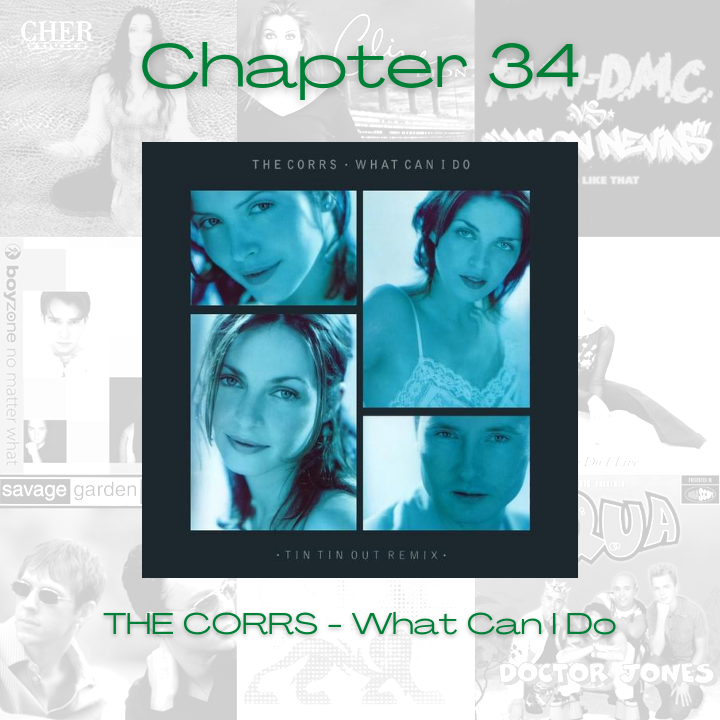
- Artist: The Corrs
- Song: What Can I Do
- Released: 16/03/1998 (Original) / 17/08/1998 (Tin Tin Out Remix)
- Writers / Producers: Andrea Corr / Jim Corr / Sharon Corr / Caroline Corr / Tin Tin Out
- Highest UK Chart Position: #3
- Weeks on Chart: 15
We did say earlier on this series that acts from Ireland had a particularly strong year in 1998. And when it came to Irish music, there were few bands who were as big as this week’s featured band were. However, it didn’t start off that way – at least, not in the UK.
Hailing from Dundalk, a town lying not far from the border with Northern Ireland, The Corrs – consisting of sisters Andrea, Sharon and Caroline and brother Jim – first came to attention earlier in the 90s, after all winning parts in the 1991 big screen adaptation of Roddy Doyle’s novel, The Commitments, about a young soul band formed in the North side of Dublin.
It was here that their manager John Hughes spotted them, and they gradually started building their sound and finding their feet as a band, mixing contemporary pop music with traditional Irish sounds via fiddle, tin whistle and bodhran. It was after being invited over to play a show in New York in 1994 by the then American ambassador to Ireland, Jean Kennedy Smith, that they decided to shop for a record deal.
After rocking up at the famous Hit Factory Studios, where he was overseeing production on Michael Jackson’s HIStory album, they approached David Foster, and he signed them to Atlantic Records on the spot. Staying in the States for five more months, they eventually recorded and released their first album, entirely produced or co-produced by Foster, called Forgiven Not Forgotten, which was released in 1995.
Although an immediate success in Ireland, and in other territories such as Australia, Japan, Canada, Norway and Spain, but as mentioned above, in the UK things hadn’t taken off in quite the same way. So it is perhaps little surprise then, that for their second album, Talk On Corners, working with the varied likes of Glen Ballard, Oliver Lieber, John Shanks and Carole Bayer Sager, The Corrs were about to evolve their sound to take them to what would ultimately be their worldwide breakthrough.
First released in October 1997, and preceded by the singles “Only When I Sleep” and “I Never Loved You Anyway”, it had had a fairly slow start once again here in Britain. What really got the album cooking on gas was two things: the first being the broadcast on the BBC of their St. Patrick’s Day concert at the Royal Albert Hall in London in 1998, where they performed with Mick Fleetwood.
The second was their invitation to record a cover of Fleetwood Mac’s “Dreams” for a tribute album to the iconic rock band’s album Rumours, which was then celebrating its 20th anniversary. A thundering remix of their cover by Todd Terry was responsible for propelling the band into the UK top 10 for the first time that May, where it peaked at #6. A few weeks later, with “Dreams” bolted onto Talk On Corners, it began it’s first of four seperate stints at number one in the UK album chart.
Atlantic thus reasoned that if this remix could help them crossover to become big chart and radio stars, it must surely stand to reason that a similar approach could work for their original material. “What Can I Do” had already been released as the third single earlier in the campaign, in March 1998. That time around, it had stalled outside the top 40 at #53. Commissioned for remix duties on the re-released single were Tin Tin Out, following their own huge success with “Here’s Where The Story Ends” we covered earlier this series.
They elevated it to something that was thus a little more fitting for radio at that time, but what it crucially did was open them up to audiences who might have been undecided on The Corrs on the strength of “Dreams”, to show their original material was equally worth pursuing. It’s simple but photogenic video, filmed in New Zealand while they were on a day off from their tour, immediately positioned the band – but especially Andrea – into many affections.
As the Talk On Corners album returned once again to the top of the chart, the reactivated “What Can I Do” came out in August 1998, entering and peaking at #3. And from there, The Corrs’ success grew and grew exponentially in the UK. The next single, another remixed cut, this time of “So Young” from K-Klass, gave them a third top 10 hit that November, and preceded a reissued special edition of the album featuring all the remixed singles, as well as another Tin Tin Out rework of their first single from their debut, “Runaway”, which peaked at #2 the following February in 1999, just agonisingly missing out on number one to Britney Spears.
In all, Talk On Corners went on to spend an incredible 10 weeks at number one and well over two years in the UK album chart, and with sales of over 2.96 million copies, it was the UK’s biggest selling album of 1998. By March 1999, both that and their first album, Forgiven Not Forgotten – which was playing long overdue sales catchup – occupied both the number one and number two positions in the album charts; a first in chart history at the time.
The Corrs remain one of the standout examples of why Irish music enjoyed such a purple – or should that be green? – patch in the UK charts towards the end of the 90s. Their music cleverly combined the musical heritage of their home turf, but moved it forward for radio friendly accessibility that allowed them to gain a wider audience, which was not to be sniffed at all. Not when songs like “What Can I Do” had their charm and appeal – even if it took two releases for people to realise it.
Don’t forget to follow our brand new playlist on Spotify – updated weekly so you never miss a song from the story of pop in 1998. And you can leave your memories of the songs below in the comments, Tweet us or message us on Instagram, using the hashtag #StoryofPop1998.

 The Niche Reference