

Well hello to you and welcome back to this here corner of the interweb in the year of our Lord 2024, and welcome back to Pop Essays!
Regular readers may remember that this was the series we started about three years ago, wherein we shine a light on and showcase some of the lesser spotted gems that are, by some measure, the rarest in the pop constellations of all. Be it a single, album track, B-Side, track released in Japan only; if it never quite reached its full potential, has been unfairly overlooked or we just want to sing from the rooftops about it – the rule is we’re covering it.
We got up to about 28 of them last time – and thank you so much everyone who was re-reading the previous ones we wrote over the festive break, we saw all the hits and love, and it is much appreciated. So now today, the series resumes, and this week, we go back 26 years ago, with a third single from a band who had their own TV show – no, not who you’re thinking, but…
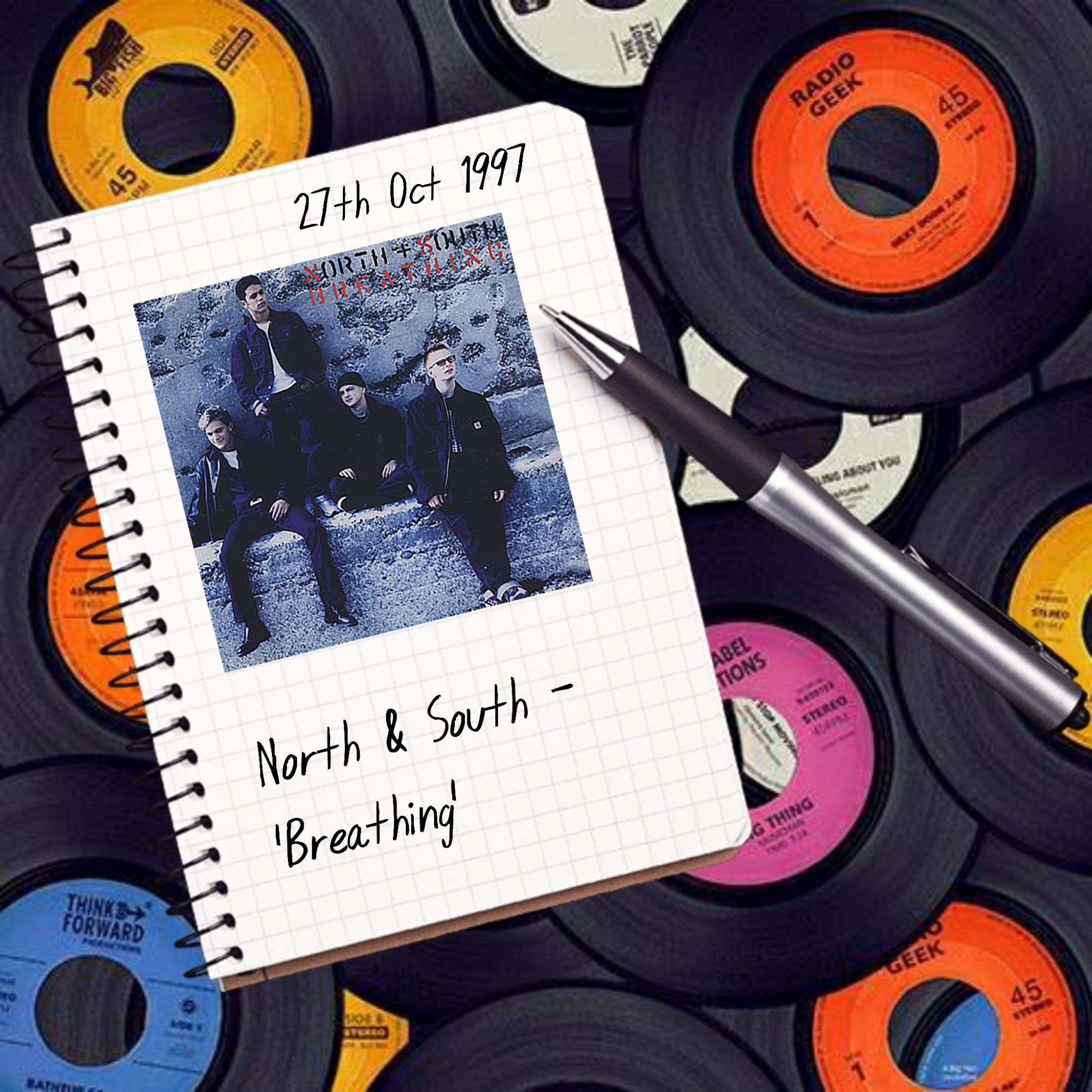
- Artist: North & South
- Song: Breathing
- Released: 27/10/1997
- Writers / Producers: Tect One / Mike Rose / Nick Foster
- Highest UK Chart Position: #27
- Chart Run: 27 – 61 – 85
Having starred in their own top rated BBC One children’s comedy drama series (No Sweat), attracting 2.5m viewers a week, and storming the UK top 20 with their first two singles, “I’m A Man Not A Boy” (#7, May 1997) and the barnstormingly brilliant “Tarantino’s New Star” (#18, August 1997), North & South had introduced the relatively new concept of launching a major new pop band via an equally major TV show and seen it pay off. Well, almost.
The trouble was, 2.5 million viewers of their CBBC show was not turning instantly into 2.5 million single sales. Loitering in mid table by their second single, there was clearly work to do if they were to avoid being in a position that no major label 90s or 00s pop band with a lot of financial investment in them ever wanted to find themselves in, let alone one with a TV show to their name. So as the nights drew in and the march towards Christmas began, so too came their third single.
Once upon a time, back in the days long before cries of “Alexa, play Christmas music” and streaming services’ own festive playlists of the usual suspects – Wham, Mariah etc – saw to it that the singles chart effectively went into hibernation from mid-November until the beginning of January (as it indeed has done again this last year), releasing new music in the crucial Q4 run up was once a lucrative move for pop music acts.
Sales – as then, although nowhere near as higher – were at their highest in the last three months of the year. And in 1997 in particular, the CD single had entered its imperial phase – and how. From the middle of June until the year’s end, the number one single had consistently notched up a weekly six figure sale, and a number of massive selling, long running chart toppers in the process, such as Puff Daddy and Faith Evans‘ “I’ll Be Missing You”, Aqua’s “Barbie Girl” and, perhaps most famously of all, Sir Elton John’s history books rewriting re-recording of “Candle In The Wind” for Princess Diana. Supermarkets, realising how profitable they were, also started stocking the singles chart, thus turning the CD single into an affordable and hugely popular form of music consumption.
It’s easy therefore, to see why a pop band’s best route to success at that time after their first two singles, was a ballad released in the chillier months. Even if they weren’t in contention for Christmas number one, they stood a very good chance of having a visible presence on the Christmas chart by the time it rolled around, and thus the extra sales that bought.
An excellent article was written by Matt Charlton for The Guardian about a month ago, which both explored and mourned the loss of the “seasonal ballad” in pop music in recent years. Not in the Westlife or Boyzone sense, you understand; almost all their singles, with a couple of exceptions, were aimed at air grabbing and emoting, regardless of the time of year. No, more specifically, it was those from pop bands known largely for their uptempo bangers who, once in a while – usually in Q4 – slowed the tempo down, donned winter wear and got all wistful and doe eyed in the video.
See East 17’s “Stay Another Day”, Spice Girls’ “2 Become 1”, S Club 7’s “Never Had A Dream Come True”, Girls Aloud’s “See The Day”, Take That’s “Babe” and Sugababes’ “Too Lost In You”. In fact, East 17 are the connector here where North & South are concerned, in that they shared a manager in the notoriously outspoken and larger than life Tom Watkins, who had put the latter together through auditions advertised via that most 90s medium possible: Teletext (ask your mum if you don’t know what that is, readers born after 1997).
His autobiography “Let’s Make Lots Of Money: My Life as the Biggest Man in Pop”, published just before his death in 2020, touches on 1997 as a period of him reaching a point of utter fatigue with pop music management. Following the acrimonious break up of East 17 (which we would argue he partly engineered, but that’s for another blog), his energies (or what was left of them) were concentrated towards North & South.
But even this was done without much enthusiasm. In his book, he spoke of his disdain for them wanting to be credible after realising they wanted a hand in the music they were making, and dismissively referred to their debut single “I’m A Man Not A Boy” as ‘Drop The Boy redux’ – a song that had been a hit for one of his best known charges in the 80s, Bros. It’s being slightly unkind, we feel; “I’m A Man Not A Boy” was still a great pop record, perhaps lacking a chorus that wasn’t repeated ad infinitum, true, but it’s anthemic quality made the desired impact.
And going on the account of James Hurst, the band’s multicoloured haired guitarist, who was just 16 when he joined, it didn’t necessarily seem like it was a happy place to be in the band beyond that first single. Speaking to The Guardian in 2001, he said: “We didn’t have any say in anything we did, so all we did was moan about it every day … Then you get perceived as a bunch of kids who don’t know what’s good for them, so enthusiasm for the band diminishes. Nobody wants to invest in a band that isn’t making any money and doesn’t want to do it either.”
It is a shame in many ways that so much conflict and animosity lay at the heart of the project at a time when everyone involved crucially needed to be a united front. Because actually, with “Breathing”, they had something brilliant. A glacial drop of cascading, ethereal synths that fall like midwinter snow usher in the song, as Lee Otter delivers the opening lines: “When I’m dreaming / I need you to believe in / I picture you / With both eyes closed, I can touch you / It’s my reason for being, a new way of seeing / Deep, deep breathing”.
And whilst the chorus was very much one refrain repeated over and over as epic power drums gradually build throughout: “Aaah, aaah, aaah, breathing you”, its haunting, choir like delivery, with soulful ad libs from Tom Lowe at its climax, elevated it to something quite magical. It’s simplicity was one of its key strengths, and it’s sound immediately called to mind longer, colder nights. It also showed another side to them musically for anyone who only knew of them from the singles and hadn’t seen No Sweat on telly to know of their other songs (“Breathing” was used extensively for the storyline involving Lee, in his on screen character of paper boy Greg, falling for Jasy, the posh girl from a rival school, played by now West End leading lady and niece of Bonnie Langford, Scarlett Strallen).
Likewise, the music video was visually a lot less busy then their previous two had been; it’s a lot of hand held Super 8 camera projections of the band, and out of focus shots interlaced on top of one another, as performance shots of them alternate with shots of them in what can best be described as a circle of bean bag chairs. Nothing earth shattering, granted, but then, it was a video for a slower song, so it didn’t really need to be.
The plan with “Breathing” was for it to be released at the end of October (which did happen) as the band headed out on a sold out UK tour (which did happen), with the album, then provisionally titled The News, to follow (which didn’t happen), and a Christmas special of No Sweat, featuring footage from the boys’ Colchester Charter Hall show of the tour, presented by Gail Porter (which we tried to get tickets for and failed) was also planned, and aired on CBBC over the festive period.
It doesn’t take Poirot to work out that somewhere along the way, this plan went awry. The Christmas special airing some seven weeks after the single’s release – and the album’s intended release – was making an exceptionally brave assumption that they would still be on the chart with both at that point for it to have a beneficial impact. Meanwhile, back in the real world, “Breathing” debuted and peaked at #27, exiting the chart altogether after just three weeks.
And thus North & South were officially underperforming, and couldn’t catch a break from thereon in. Their debut album, then retitled to Allsorts, was scheduled to finally come out following a remixed version of the No Sweat theme tune (“No Sweat ’98”) ahead of the second series starting on BBC One in April 1998. After that single too flopped (#29), RCA Records cut their losses, and the band were no more.
There’s all kinds of variables at play when looking hypothetically at that cruelest of situations where a pop band are quite simply not popular by the usual measures. On reflection, it was probably a number of things at the heart of the matter that derailed North & South before they even got started.
Yes, No Sweat had been a big success. But the truth is that the music was probably that bit too “out there” for its own good – certainly by 1997 standards. Commercially, it was giving more Ant and Dec as PJ & Duncan from Byker Grove than it was S Club 7 in Miami 7 (although that’s not necessarily a bad thing), which followed two years later to even bigger success. You almost think they would have made more sense a couple of years later, when say, Five oftentimes released the musically baffling (hello to you, “Everybody Get Up”), but they made it make sense. But pop in 1997 wasn’t quite ready for a band that threw caution to the wind musically speaking. Add in the internal politics discussed above, and it’s easy to see why it didn’t work as it should have done. But “Breathing” is undoubtedly a worthy addition to the great wintry 90s / 00s pop ballads canon. Try it on your next walk on a crisp, cold day (which there is ample opportunity for over the next week) and tell us it works.
Don’t forget to follow our Pop Essays playlist on Spotify, which includes this and all the songs we’ve written about. What are your memories of this week’s featured song or band? Let us know your thoughts in the comments below or message us on our Instagram.

 The Niche Reference
One thought on “Pop Essays #29: North & South, ‘Breathing’”