


Digging the lesser tracked grooves of musical yesteryear, it’s time for another of my Pop Essays. This week: a reflective moment from the debut pop album of a classical crossover star…
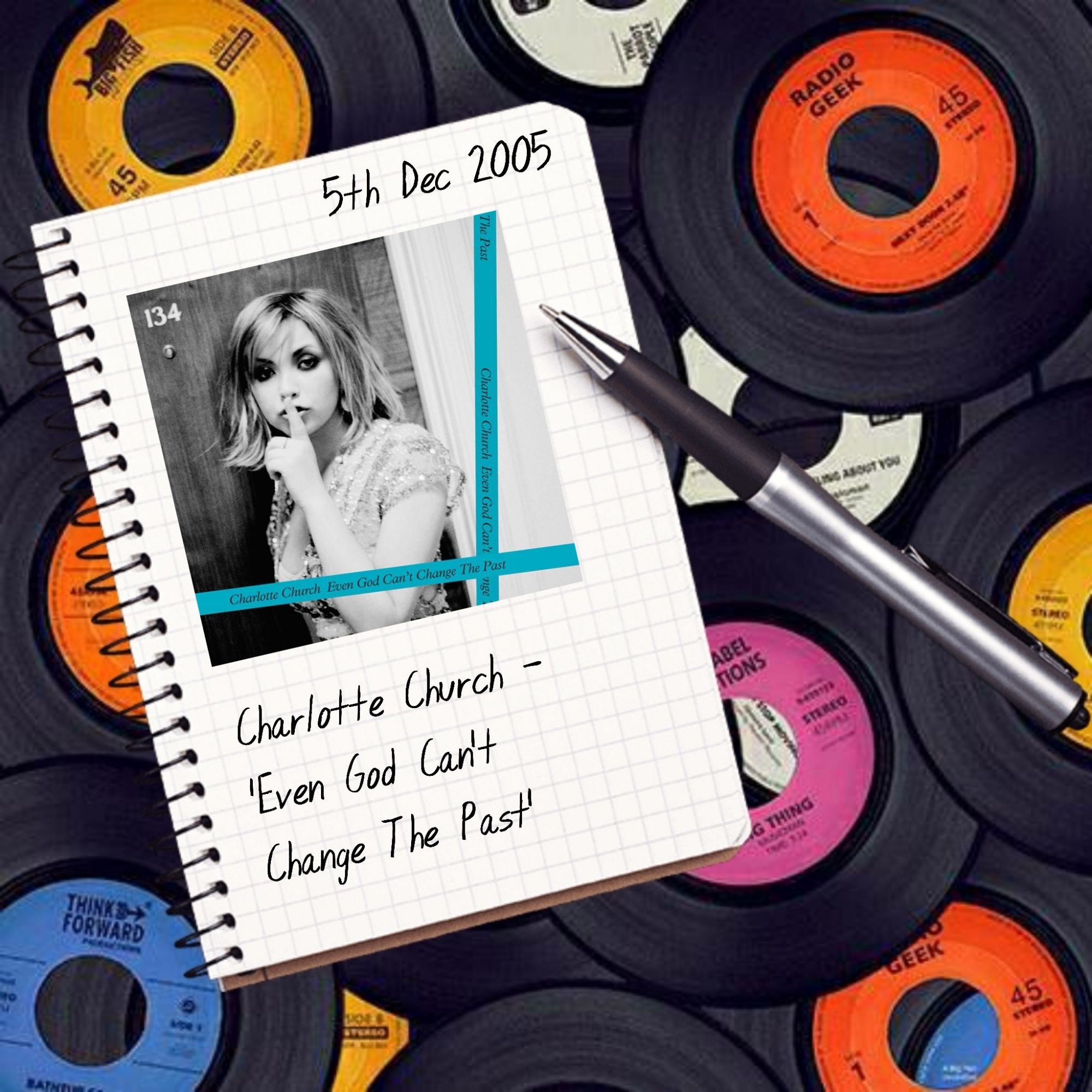
- Artist: Charlotte Church
- Song: Even God Can’t Change The Past
- Released: 05/12/2005
- Writers / Producers: Rick Nowels / George O’Dowd / John Themis / David Fortman
- Highest UK Chart Position: #17
- Chart Run: 17 – 29 – 45 – 61 – 72 – 91 – 99
One of the biggest stories of the year in pop in 2005 had undoubtedly been the unlikely transition of a young classical soprano into a fully fledged pop singer. Having made her name as the “Voice Of An Angel” seven years previously, as she matured into a young woman, Charlotte Church made the transition to contemporary pop and rock.
However, it was a journey that was a tricky one overall, and one that ended up the product of a hefty amount of compromise. Her first steps away from classical music had come in 2003, when she provided guest vocals to “Brave New World (The Opera Song)” by DJ and producer Darren Tate, aka Jurgen Vries, which was a top 3 hit in January that year.
Fast forward two years, and in the summer of 2005, she made her full scale debut as a popstar with the belting and brassy Motown-esque “Crazy Chick”. However, it was one of several songs added to the album at the last minute at her record label, Sony Music’s request, as they felt what songs were on Charlotte’s debut pop album that she had co-written, Tissues and Issues, were not exactly standing out as single material.
It was also – as both this ITV2 documentary of the time and her 2007 autobiography, Keep Smiling, will testify – not exactly a song that Charlotte was that convinced about recording, let alone endlessly promoting and performing. But it was an instant hit nonetheless, roaring straight into the UK chart at #2 at the start of July, with the Tissues and Issues album following it into the top 5 of the album chart.
This was then followed up in September with the equally bold and showstopping “Call My Name”, replete with a playful video (directed by Michael Gracey, fact fans) which saw Charlotte dressed as what can only be described as a showgirl crossed with an extra from Moulin Rouge. A second top 10 hit followed, even if it, surprisingly, only managed a #10 peak.
However, whilst she was gaining a new audience, her existing audience from her classical career, who were more accustomed to her sweetly singing “Pie Jesu” or “Carrickfergus”, were reported shocked and alarmed in Berkshire over such a drastic move, and decrying that a young woman with her own independent mind was embracing that. Alert the church elders, etc.
Of course, compounding all of this was the relentless media pursuit of her and her family from as young as 11 years old, which – as her testimony at the Leveson inquiry in 2011 documents – was relentless and ruthless, and veered deeply into the bad taste and creepy (News Of The World having a countdown clock to her 18th birthday being one, being awarded Rear Of The Year in 2002 when she was 16, another). Little wonder singing and promoting “Crazy Chick” got real old, real quick for Charlotte.
But it was not the only song she was against the release of as a single; for as 2005 drew to a close and Christmas edged closer, the third single from Tissues and Issues saw the pace slow down as she switched into ballad mode. One glance at the writing credits for the chosen single might offer explanation as to why.
“Even God” had been written some years previously by one George O’Dowd – otherwise known of course, as Boy George from Culture Club. It was co-written and produced by Rick Nowels, who had worked with, amongst others, Madonna, Dido and Melanie C. He was usually reluctant to let other people record and cover songs he’d written, but on this occasion, was so moved by Charlotte’s version, that he gave her his blessing.
It is also as far removed from the first two singles as it was possible to get; a dramatic, cinematic swirl of strings ushers in the song, before giving way to a gentle piano and the central chorus line: “Even God can’t change the past / No matter how many tears I’ve cried / Yes I thought this love would last / Who am I to question why? / Who am I?”
In fact, there is an almost theatrical quality to the song, like it could have been lifted from a musical, where a main character was having a reflective moment (“I can see your face / Even when I close my eyes / I can give you love / Even when I’ve been denied”), and it’s easy to see why Boy George was moved by Charlotte’s performance of it; her voice has the power and delivery to make it soft at the quiet bits and strong at the bits where the song swells to its crescendo.
One beautiful example of this is in the middle 8 prior to the final chorus: “They try to break you / They try to steal your stars / If they ever take you / Just remember who you are / They try to hate you / Just like some love bizarre / It’s a sign of weakness / To be afraid of what you are”.
Charlotte had pushed for another slower song from the album, the free verse sounding meditation of “Confessional Song” that she had written with Guy Chambers, to be a single. But she came at loggerheads with her then label A&R, one Nick Raphael, who was adamant that “Even God” – now retitled to the slightly wordier “Even God Can’t Change The Past” – was the third single.
And whilst the video, which was fitting for the time of year, and saw Charlotte moves seamlessly between changing setups, almost like a moving painting, it was a lot less busy than the other two videos had been. All in all, it was certainly a change of tack that was a gamble, throwing a lot of visual and audial information which would either win more of her new audience over, or consolidate and bring some of her older audience back.
In the event, it did neither, as “Even God Can’t Change The Past” stalled at #17, and was out the top 40 by Christmas. It briefly returned the Tissues and Issues album to the bottom end of the top 75 on the album chart, but even though a fourth single – “Moodswings (To Come At Me Like That)” followed a few months later in March 2006, that too only went as far as #14.
Over a year passed, by which point Charlotte moved into light entertainment hosting and starring in her own late night chat and comedy series, The Charlotte Church Show, for Channel 4, which won her several British Comedy Awards. She quietly parted ways with Sony Music in the interim, and it would be another four years before her next album, the self released Back To Scratch, in 2010, and a series of EPs released in 2013 – 2014.
One criticism that was levied at Tissues and Issues was that, for someone with such power and presence as Charlotte, it frequently seemed to be less than the sum of its parts; something not helped by the label pushing on songs that were radio friendly “singles” when they got cold feet over what she had written and produced with others.
But perhaps, as Charlotte would probably admit herself, being a larger than life, heavily promoted popstar was never really what she was enamoured by. So in that sense, there was only ever likely to be one outcome. But whilst commercially not a success, “Even God” reminds you of the depth and gravitas she could bring to a contemporary song such as this one.
Don’t forget to follow our Pop Essays playlist on Spotify, which includes this and all the songs we’ve written about. What are your memories of this week’s featured song or band? Let us know your thoughts in the comments below or message us on our Instagram.

 The Niche Reference