

Hello all. Come join us now as we plough the grooves once again for more retrospective pop analysis, with Pop Essays. This week: we revisit when one of the 00s’ biggest pop bands embraced their dark side on their surprisingly maturer second album…
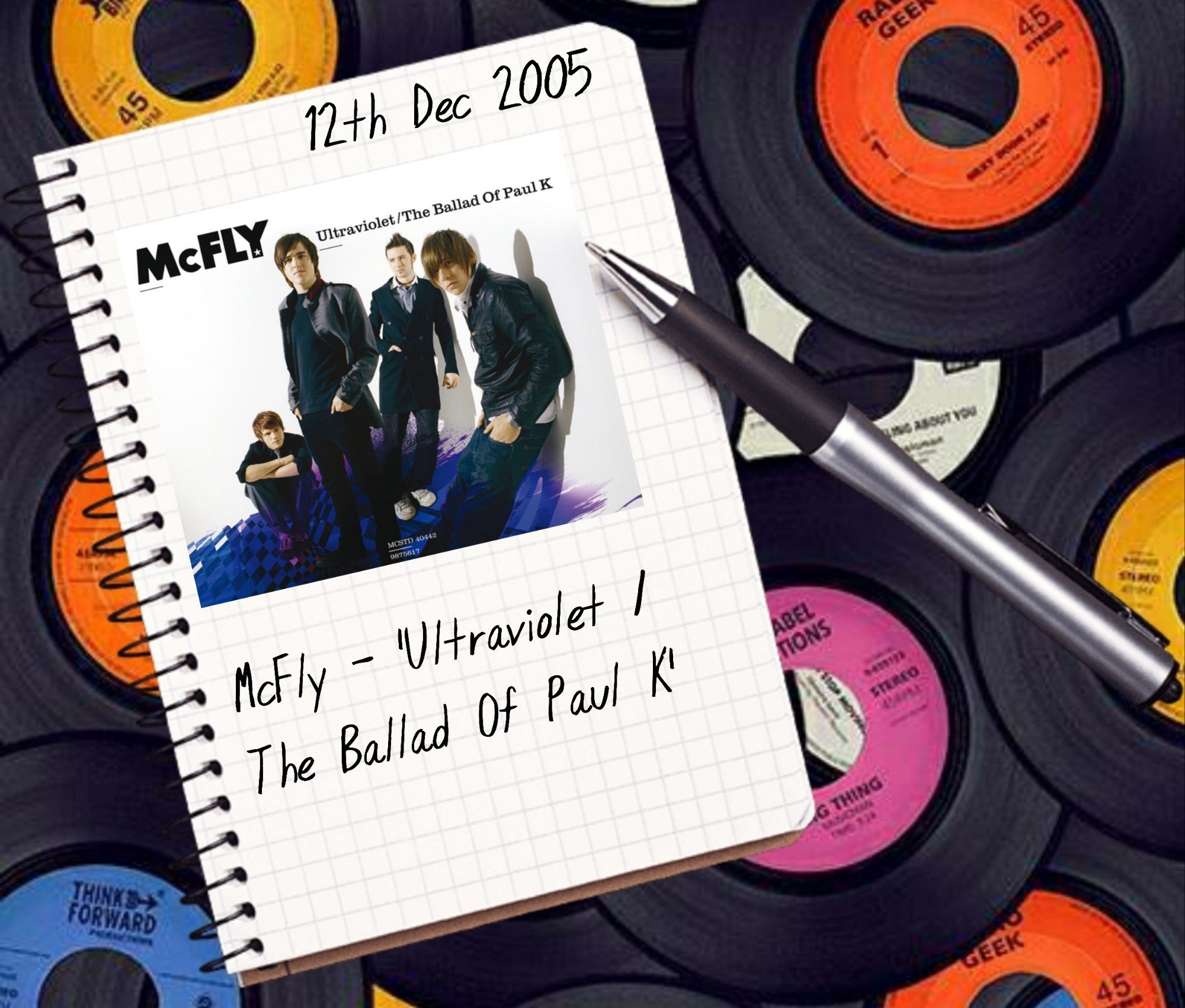
- Artist: McFly
- Song: Ultraviolet / The Ballad Of Paul K
- Released: 12/12/2005
- Writers / Producers: Tom Fletcher / Danny Jones / Hugh Padgham (Ultraviolet) / Tom Fletcher / Danny Jones / Dougie Poynter / Steve Power (The Ballad Of Paul K)
- Highest UK Chart Position: #9
- Chart Run: 9 – 24 – 52 – 61
It might have taken Danny Jones singing stupendously well in a piranha costume for eight weeks on primetime Saturday night telly at the start of this year for most people to realise it, but ever since 2004, there’s something we’ve always known to be true. And that is the brilliance of McFly.
Now, as this is their 20th anniversary year this year (and 21 years since formation, which is being marked with some special birthday shows at The O2 in London in October), we have the requisite blog about the brilliance of their overall legacy and their debut album, Room On The 3rd Floor, up our sleeves for around July time when that hits its actual 20th anniversary, but we figured an entry into this series covering one of their lesser starred hits couldn’t hurt either, for reasons which will become apparent.
As we touched on a few entries back with The Faders, at the start of 2005, McFly were in a sweet spot for new pop bands after a wildly successful 2004. With two number one singles, a number one debut album, the feat of breaking The Beatles‘ record of being the youngest band to top the album chart, and a clutch of awards and universal teen magazine and TV show adoration before them, they were about as big as you could get at that time.
On top of all this, they had also triumphed winning Best Pop Act at that year’s BRIT Awards, had signed onto cameo roles in a big budget Hollywood romcom, Just My Luck, starring Lindsay Lohan, and had been invited to record that year’s official single for Comic Relief, “All About You”, which eventually gave them their third number one hit and still remains the biggest single of their career.
On paper, it seemed like they should have been having the time of their lives. The reality however, was quite different, in many ways. Whilst they are talked about in almost universal appreciation and respect now, 20 years ago it was split down the middle. Because of their start supporting Busted on their 2004 arena tour, and their original marketing towards a younger, pop loving demographic, there was two opposing camps of thought where the boys were concerned.
It was either intense adoration of the OMIGODILUVYOU fangirl-o’clock central following their every move variety, or it was total and utter derision. There was no ambivalent middle ground where the twain met. In their 2012 autobiography, Unsaid Things, the band spoke about how they were fully aware of this, and how they were frequently used as a sitting target for insults or derision by supposedly more “trendy”, identikit indie bands feted by NME, who themselves were none too kind a publication towards them, and once captioned a picture of them in one issue with the words “(From L-R): C***, D***head, W***er and T**t”.
Of course, NME probably wasn’t ever their intended market – certainly not initially – but you would absolutely not get away with calling four still relatively young lads barely out of their teens those names in a national publication today, without sparking some form of outrage. In a time before mental health was widely spoken about, such opprobrium from the industry undoubtedly had a detrimental effect on both confidence in their ability and ultimately their wellbeing – some more than others. And thus a period of frustration started to emanate from the band, pointed specifically at the way they’d been initially projected in terms of their image and videos and (to a lesser extent) their music.
Whilst “All About You” did end up being included on their second album, to all intents and purposes, it was chosen for Comic Relief at the time because A) it’s sentiment was more fitting, which was strange as it was never actually intended to be a McFly song at all (it was a hurried Valentine’s Day present written solely by Tom Fletcher for his girlfriend – now wife – Giovanna Fletcher, and formed the basis many years later of his now YouTube famous wedding speech) and B) it stood out like a sore thumb compared to what else they were starting to concoct for the second album. Sonically, it was probably better suited to being bolted onto a special edition reissue of Room On The 3rd Floor (it’s additional production by Craig Hardy, who had also worked on “Obviously”, is surely no coincidence in why they ended up sounding similar).
But the one other fly in the ointment was circumstances that meant they were, for the next four years at least, the last active “boyband” standing; just two weeks into the start of 2005, Busted unexpectedly broke up, and even V, the short lived conventional boyband from Prestige Management, the same team that had assembled both bands, had called it quits after their debut (only) album had slid down the dumper.
With an almost fascinating parallel to the year and a bit of vulture-like doomsaying that led towards Charlie Simpson’s resignation from Busted to focus on Fightstar, the gutter red top press started reporting on McFly with near the same morbid preoccupation, as if they were willing them to do the same. Barely a week seemed to go by without a headline emerging, citing whisperings that one of either Danny or Harry Judd (both of whom were arguably the most known members of the band at that point in terms of media coverage, the latter largely because of his brief tabloid fling with Lindsay Lohan during filming of Just My Luck) were wanting to quit the band.
If you have read Unsaid Things, you’ll know that some of it was closer to the truth than anyone realised, particularly between Tom and Harry, with simmering tensions between them (some of it owing to a depressive episode of Tom’s then undiagnosed bipolar disorder) that culminated in one almighty ruckus during rehearsals for their first ever arena tour, where they came to blows over the latter’s inability to replicate a drum riff beat for beat done by the former.
With all those factors combined, it is little surprise that their second album, Wonderland, ended up coming out the way it did. At first, when they returned with its lead in single “I’ll Be OK” in August, there was little to suggest that anything had changed; on the surface at least, it seemed as if their perky, singalong guitar pop and japey music videos were still in place, and it duly flew to the top of the charts. When the Wonderland album arrived two weeks later, however, it was a different story. Even before you put the CD in the player, or pressed play on your iTunes download, the artwork alone indicated that something was up here.
The bright blue beachy skies and quirky poses on wavebreakers and VW Camper Vans in colourful skate wear of Room On The 3rd Floor, had given way to questionable mullets, a lot of SRS FACE poses (except for Dougie Poynter, who looked like he was stifling a forbidden fart), and a wardrobe entirely in varying shades of navy, black or grey, whilst the band stood at what looked like the eerie, darkly lit gates of a haunted house, surrounded by part humanoid woodland creatures, which was presumably aiming at looking like a twisted, psychedelic ‘wonderland’, as opposed to the ‘Disney Alice in wonderland’ definition, but which – unintentionally – left them looking like they were surrounded by those steampunk inspired taxidermies of woodland animals that hipsters make into beer bottles (it’s an actual thing, just FYI).
And then you put the album on, and you’re met with yes, an impressive and bold album, but one with a much harder rock sound, that couldn’t have been further removed lyrically or sound wise from anything on the first album. There’s no more japes about weirdos with five colours in their hair, or dating surfer babes at the pizza place, or even screwing up cooking broccoli for a hot chick at school here.
Instead, there’s “She Falls Asleep”, a dramatic seven minute long song in two parts, recorded with a 60 part orchestra at a cost of £1m, the first two and a half minutes of which are entirely instrumental, giving way to a sombre piano musing on teenage suicide by Tom, that for all the world sounds like it’s from a Broadway musical. There’s “Don’t Know Why”, a deeply personal song written and sung by Danny about his absent father. And then there’s the biting, Green Day-esque tale of infidelity that is “Too Close For Comfort”, arguably the single that never was from this album, and which remains a fan favourite to this day.
As the album campaign progressed, with the next single “I Wanna Hold You” (a rollicking apocalyptic love song that peaked at #3 in October), it was clear that what was emerging was a darker sounding McFly, almost rebelling against everything that their fans knew and loved them for, with a self evident desire to be taken more seriously. Even so, whilst Wonderland had given them a second number one album, the fact it ended up selling just a fraction less than half of their debut indicated that it was a very sharp and sudden about turn from a year previously, and to most, there was a sense that they were pushing what goodwill their audience had behind them in a way that few other pop bands had on their second album.
It was this goodwill which was perhaps tested to its very limits on what ultimately became the fourth and final single from the album campaign, which ended up being one of compromise. Not for the first or last time in their career, it was a double-A-side effort. “Ultraviolet” was their label, Universal Island’s preferred choice, and the song cited by most early reviews of the album as being “McFly go Sgt Pepper”, somewhat lazily on account of the fact it utilised a sitar in the mix, but which was less “Norwegian Wood”, as it was a fun, hypnotic sounding party rocker about indulging in the female attention their success of the last year had bought: “These summer girls are really something else / Our lives are short, but the nights are long”.
The other half of the single was the band’s choice, “The Ballad Of Paul K”, another of the songs written about Danny – and also Dougie’s – estranged dads, woven into what was lyrically, a moving but utterly bleak part acoustic tale about an alcoholic father hitting middle age and abandoning his family: “He doesn’t like to mention, applying for his pension / So his children don’t know he’s heading / Into a midlife crisis … He’s been a drunk all his life / Two kids a dog and a wife … Look at what you’ve thrown away, they stood beside you all the way / Now it’s too late, it’s too late for you”.
The latter track was reworked into a new orchestral mix for single release, and arguably had the more airtime and investment into its TV and radio promotion (it was the song they performed somewhat ill advisedly on that year’s Royal Variety Performance) and, ultimately, its video. Directed by Corin Hardy, who had directed “Bedshaped” for Keane, it bought the overall aesthetic and feel of the Wonderland campaign full circle, reimagining the band as stop motion animated puppets, wearing eerie looking contorted masks that were like something out of a Tim Burton movie, whilst the tragic life of ‘Paul K’ in his crooked house unravelled around them in keeping with the story of the song.
“Ultraviolet” meanwhile, had the least investment, as its promo video was the one thing most pop fans despise: a clip reel video of live performance and behind the scenes action, in this case, footage from the Wonderland UK arena tour that had just been released on DVD, thus keeping costs to a minimum, as it was essentially repurposing footage from that which had already been filmed.
Truthfully, “Ultraviolet” probably could have been a low risk standalone single in the latter part of the campaign. The same however couldn’t be said of “The Ballad Of Paul K”. In the wider context of the album, it worked, and showed such emotional depth to the guys as songwriters, singers and musicians, but bought into the cold light of day as a single, it was living and dying by its status and mission to propel them up the charts as they were (not without reason) usually expected to at this time in their career.
So there is very little way to sugar coat that the chart entry and peak of #9, and a paltry four week chart run for the single that December was, commercially at least, a disaster. Whilst it was admittedly the fourth / fifth single off an album that had been out for four months already, so was always likely to meet diminishing returns, it was not exactly positive that it was the fifth and last of five new entries in the top 10 that week, and had the igmony of being beaten by, of all things, the wretched Crazy Frog with a cover of “Jingle Bells” and MC Hammer’s “U Can’t Touch This”, that should have been strangled at birth. A more stark contrast as to what was appealing to the wider record buying audience at that time of year between that and “The Ballad Of Paul K” you could not hope to find.
The Wonderland album briefly surged for one last moment of minor glory down the bottom end of the album chart in response to the single, before exiting for good. “I’ve Got You” (heavily used in Just My Luck) appeared on and off release schedules into early 2006, but it was not to be; to all intents and purposes, the Wonderland campaign was done. It had at least served its purpose by progressing them forward, and letting them take a break for a rethink, and come back refreshed, more accepting of who they were, and more willing to embrace their true sound and style whilst building it further on their third album, Motion In The Ocean.
But this blog is far from a criticism of the Wonderland era; if anything, it is a balanced reappraisal of it that, for all of its shortcomings, was a brilliant pop rock album that was ambitious, rich in depth and experimental, and demonstrated one thing about McFly which is part of the reason why we are still talking about them and they still have a career two decades on; their willingness as a band and as musicians to take risks and push the envelope as early as their second album, even if it bought them to near unravelling. It’s a vital piece of the puzzle that makes the rest of their career history complete and also, crucially, make sense.
Don’t forget to follow our Pop Essays playlist on Spotify, which includes this and all the songs we’ve written about. What are your memories of this week’s featured song or band? Let us know your thoughts in the comments below or message us on our Instagram.

 The Niche Reference
Great write-up, on a band that were very unfairly maligned at the time. I don’t have anything original to add, although I must admit that ‘Wonderland’ was, and may still be, my joint least favourite McFly album (not including their two, fairly mixed recent albums). I just felt they overreached with the 10 minute, three-part rock operas, and the lead single ‘I’ll Be OK’ was average. The two songs you highlight in this post, however, are brilliant, as is ‘I wanna Hold You’, so maybe I just need to go back and listen to it properly again. Anyway, McFly deserve all the reappraising they can get!
LikeLike