

Tally ho, and welcome to this week’s Pop Essays. Given that this week was no ordinary Thursday, and I figured all social media attention would be diverted away from my common or garden retro pop larks, I elected to move this post to a Saturday just for one week. In fact, timingly, by the time you read this I will be down in Margate for a long weekend to see the very band I’ve written about today. For it’s a bit of a special one I’ve chosen to write about this week, as for the first time ever on this series, I am covering a UK number one hit. All will become clear as you read on, so buckle in as we ask the question: How do you solve a problem like a lead single?
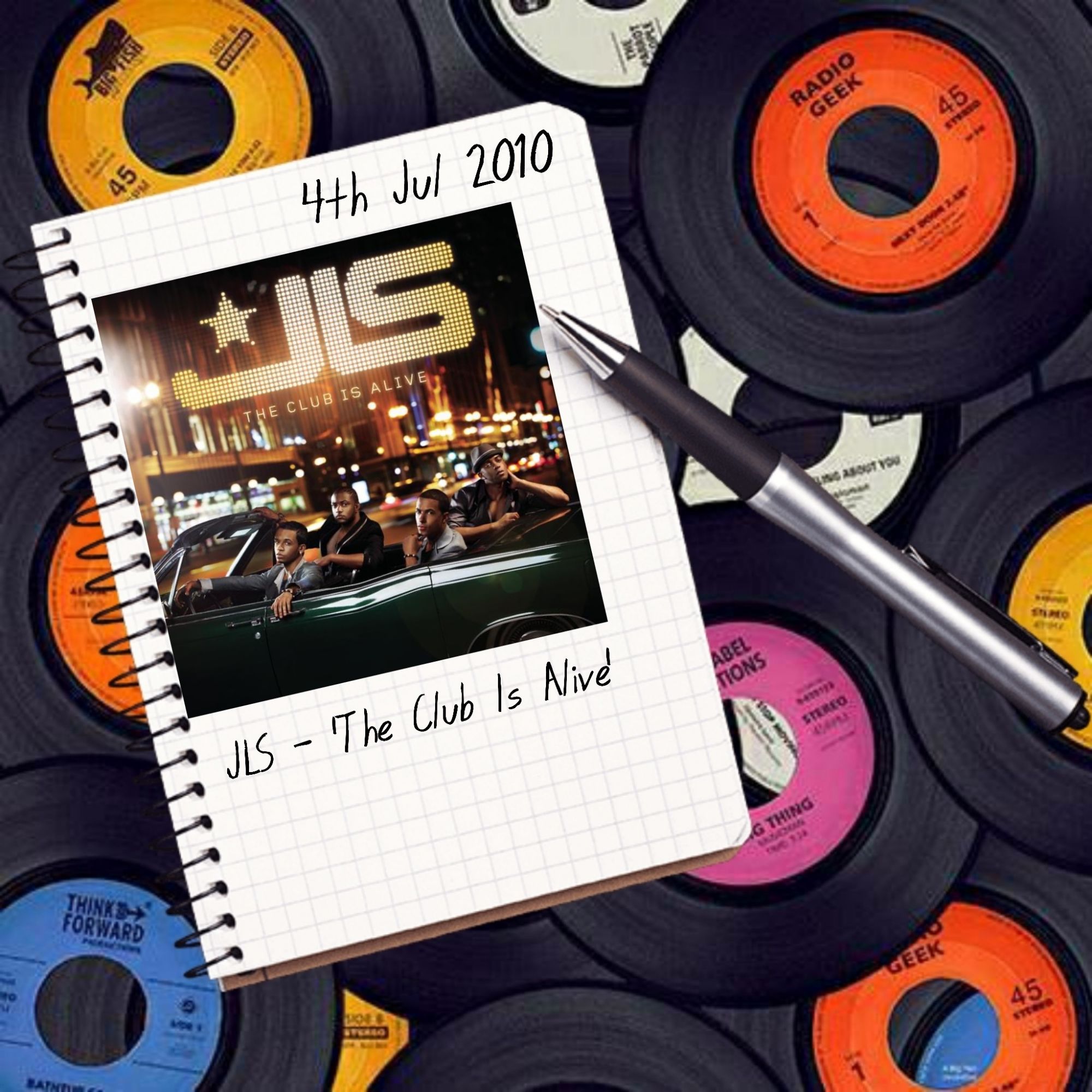
- Artist: JLS
- Song: The Club Is Alive
- Released: 04/07/2010
- Writers / Producers: Steve Mac / Andrew Frampton / Savan Kotecha / Richard Rodgers / Oscar Hammerstein II
- Highest UK Chart Position: #1
- Chart Run: 1 – 7 – 9 – 16 – 23 – 32 – 39 – 53 – 63 – 81 – 91
In terms of debut album campaigns – and ones by former finalists on The X Factor, at that – JLS had not only enjoyed a flying start, but had also arguably set the gold standard for others from the show to follow; where they had truly stepped outside their roots and made becoming runner up a positive set of circumstances, to become the biggest new boyband in a generation.
With a million selling, chart topping self titled debut album, three top 10 hits, including two massive number ones (“Beat Again” and “Everybody In Love”), a sell out tour, two MOBO Awards and two BRIT Awards, they had every reason to feel confident as they moved onto the recording and promotion of their second album in the summer of 2010. And then came “The Club Is Alive”…
On paper, it seemed as if things were starting much as they had a year previously. On Marvin Humes‘ birthday in 2009, Nick Raphael, their then A&R and head of their label, Epic Records, had sent him an email with a demo of a song that was provisionally titled “Forever And A Day”, which of course went onto become “Everybody In Love”.
Now, a year on, he received another birthday email with a demo from Nick; this time it was for “The Club Is Alive”. It’s worth pointing out at this juncture that another development had occurred towards the end of the first album campaign; namely, interest from across the pond, in America. Jive Records, the label that had been home to Britney Spears, Backstreet Boys and *NSYNC, were interested after label bosses flew over to see them on one of the London dates of their first UK tour, and had signed them on the spot.
It meant that, bar condensed trips home to do their summer outdoor shows and promote this single, they would almost exclusively be away from British soil for at least four months. True, a lot of that time was spent writing and recording their second album to come home and promote and tour arenas with at the end of the year. But there’s an argument to be made that they were also away at a time when they probably needed to focus on consolidating their initial success and audience first, before exploring and trying to crack the biggest international territory.
It’s not to say they weren’t capable or talented enough to do it, or indeed scared of the hard work that came with travelling to every State imaginable and performing on every radio station, television show, magazine and theme park that would have them, far from it. If there’s one thing they were renowned for, it was their dedication to grafting away combined with their talent; after all, that’s what had brought them their huge success after The X Factor.
But by their own account, it was almost as if Jive Records didn’t quite know what to do with them and were never fully on their side. True, Justin Bieber had just broken through in a big way and had reawakened North America’s teeny bopper market, but boybands really hadn’t been a big thing in America since *NSYNC – eight years ago at that point. Natural audience resistance, therefore, and them heading out to any old tinpot station or theme park in Wyoming or the Dakotas to try and turn that around on its own was hardly helping anybody.
And indeed, according to both Aston Merrygold and JB Gill in the band’s 2013 book Forever And A Day, it was a botched performance on a live morning TV show, screwed up by an incompetent PA assistant on the sound system, that seemed to be the catalyst for feeling like they weren’t fully supported by Jive Records and their quest for Stateside success being curtailed before it had even really got under way properly.
Consequently, this focus – albeit a brief one – on Stateside success is probably why “The Club Is Alive” could only ever be the lead single from their second album, titled Outta This World, as it was the most in tune with what was happening musically Stateside at that moment, whilst moving their sound on from their first album. Since Black Eyed Peas had made their futuristic diversion into dancefloor friendly bangers a year previously on the likes of “Boom Boom Pow” and “I Gotta Feeling”, US R&B pop with EDM influences was suddenly all the rage. From Iyaz’s “Replay” and Jason Derulo’s “Ridin’ Solo” and “Whatcha Say”, to Usher and will.I.am’s “OMG” and Akon’s collaboration with David Guetta on “Sexy Chick”, laser beams were aloft the world over.
The problem was that, like most commercially popular expansions of sounds, it was fast reaching saturation point by the time the summer of 2010 rolled around. What this meant for JLS was that, as Britain’s biggest boyband – and pop band generally – of that moment, they were at the exceptionally fickle end of the music industry, and that, in turn, meant they were that bit more vulnerable to their critics, who were waiting to unleash a visceral dose of tall poppy syndrome. And in the case of this single, that meant there was no sitting on the fence about it, and nowhere to hide.
Because “The Club Is Alive” is one of those records that you can’t feel indifferent about – you either love it or hate it. The man at the writing credits alongside Steve Mac – who had of course written “Beat Again” – on this single was Savan Kotecha, a Texan born songwriter of Indian descent, who had worked extensively with one Max Martin.
His previous writing credits included “Obvious” and “Us Against The World” for Westlife, “If U Seek Amy” for Britney Spears, and – of notable interest where this song is concerned – “If That’s OK With You” for fellow X Factor alumni, Shayne Ward, which had similarly divided audiences when released (albeit as a hastily repromoted double-A-side with “No U Hang Up”, which Savan had also co-written) as the first single from his second album, Breathless, in September 2007, peaking at #2.
It’s a good reference point here (and not just because of where both acts got their start) as, like that single, this one isn’t afraid to indulge in the bombastic and ridiculous turn of phrasing in the lyrics, as evidenced in the bridge – “You could be the DJ / I could be the dancefloor / You can get up on me” – or in the bonkers sound effects and use of autotune. It fully commits itself to being an unadulterated, glowsticks aloft, WKD fuelled bit of EDM R&B pop, best enjoyed on a crowded dancefloor.
If there’s one downside of this though, it’s that the use of autotune is almost that bit too liberally applied for its own good. Everyone knew that JLS were amazing vocalists with a dab ear for four part harmonies, from seeing them weekly on primetime ITV for nigh on three months at the end of 2008. But those looking to knock them down took it as ammunition to prove otherwise.
And that’s all before we’ve even got to the real central part of the song in the chorus – namely, it’s sample from the soundtrack of the classic Rodgers and Hammerstein musical, The Sound Of Music. Admittedly, this was not the first time in recent years that Julie Andrews had been tapped into as a source of inspiration for a contemporary pop / R&B number (in fact, Julie herself gave the boys her blessing when she heard the song).
In 2003, Big Brovaz had scored a big #2 hit with “Favourite Things”, reworking the original’s declaration of loving raindrops on roses and whiskers on kittens for “Gucci dresses and drop top Kompressors”. Then three years later, in 2006, Gwen Stefani had adapted “The Lonely Goatherd” into “Wind It Up”, the first single from her second album, The Sweet Escape.
The latter in particular had completely divided fans and had been savaged by critics, decrying the sacrilege of it all that had been committed, yet it still went onto be a big hit. So too then, was “The Club Is Alive” dismissed, namely for the way it took the musical’s central theme and reworked it thus: “The club is alive with the sound of music / Who’s that girl in the spotlight? / Ooh cause she turns me on (1,2,3,4!) / The club is alive with the sound of music / If it’s you in the spotlight / Ooh girl your turn me on / Bring it back back, baby baby like that”.
As the single went all in, so too did the video. Directed by Frank Borin, it fully commits to the nightlife aesthetic conjured up in the lyrics, as the boys pull up to a club in downtown Los Angeles in a convertible set of wheels (in a nod to the title sequence of the HBO series Entourage), and sees them living their best life, dancing up a storm on a rotating stage, toasting with champagne and flirting with a bevvy of scantily clad beauties. Even though they had already shot a video in America before, it was arguably the first video of theirs that positioned them as looking and sounding like potential Billboard Hot 100 conquering megastars.
Except, even with this song added to a self titled EP for the US market, culling together their singles so far and a handful tracks from their debut album in the UK – and which was also originally set to feature a genuinely brilliant J.R. Rotem produced song called “Hey Mama“, lined up as their second US single as a duet with Shontelle, of which only a potato quality US morning TV performance exists on YouTube, and which was pulled at the last minute – America alas remained resolutely immune to the charms of JLS, and they and Jive Records quietly parted ways.
Back home in the UK, however, even with the critical mauling that “The Club Is Alive” had received, with their popularity and audience still as massive as it was, it’s success was pretty much locked on, and it duly became their third number one single in July 2010.
However, it’s first week sales of 84,283 copies were both front loaded (it led the top of the iTunes chart all week, until being caught on the Friday by B.o.B and Hayley Williams with “Airplanes”, which ultimately knocked it off the top spot the following week, down to #7), and also some way short of the impressive six figure sales their first two number ones had opened with.
Spending just two more weeks in the top 10, and seven weeks altogether in the top 40, whilst it did sell over 200,000 copies, it was one of the lowest selling number ones of the year, finishing as the 87th best seller of 2010. Overall, there was an overwhelming sense that this wasn’t the best look for the lead single off a second album that was still some months away from full release.
Then came the arrival just three weeks later of the debut of their first real contenders to the boyband throne in The Wanted, who debuted at number one with their first single “All Time Low” – which shared writers and producers with “Beat Again” in Steve Mac and Wayne Hector, together with Ed Drewett, and which sold more and spent double the amount of time this single did on the charts – and of course, the formation of One Direction on that year’s series of The X Factor.
The arrival of serious competition was then compounded with a semi-large wave of public and (largely) media led backlash and ridicule akin to that at the height of the Spice Girls‘ global success, when, following a range of official merchandise including (but not limited to) dolls, sticker books, stationery and bedding, they announced their partnership with Durex on a range of condoms, which was overlooked entirely in its good intentions to promote safe sexual health to their audience (the slogan “Just Love Safe” was a winner) and also its benefits as a not for profit endeavour (all royalties from the sales were donated to supporting sexual health projects and endeavours, along with their charitable foundation, split four ways between NSPCC, Beat Bullying, the National MS Society and Rays of Sunshine).
Fortunately, they did pull things back after this storm in a teacup with their next single, “Love You More”, their self penned soulful power ballad which was that year’s official single for BBC Children In Need, and which returned them once more to the top of the chart and six figure sales that November, whilst the Outta This World album was another double platinum seller, spawning a further huge top 10 hit with “Eyes Wide Shut” featuring Tinie Tempah, in February 2011.
Whilst it still remains a staple and highlight of their live tours, there is little disputing that it’s difficult history has meant that, until now, “The Club Is Alive” has continued to be regarded as the tough chestnut of JLS’ singles, and the least fondly thought of of their five chart toppers, marking the point where their critics had found a kink in their otherwise infallible armour. For all of it’s complexity in industry politics and critical snobbery at the time though, we say, at the heart of it all is still a brilliant pop song that – appreciated and taken for what it is – is a fine example of their ability to deliver an OTT kitchen sink anthem that captures their undeniable energy at its best.
Don’t forget to follow our Pop Essays playlist on Spotify, which includes this and all the songs we’ve written about. What are your memories of this week’s featured song or band? Let us know your thoughts in the comments below or message us on our Instagram.

 The Niche Reference