

Well, I did say I was getting back to my regular writing ways, and I am nothing if not a man of my word. So here once again is Pop Essays, the series where I delve into the deeper grooves of my pop music loving from the last 25 years or so. On this edition: when you’re a clone, you know you’re never alone…
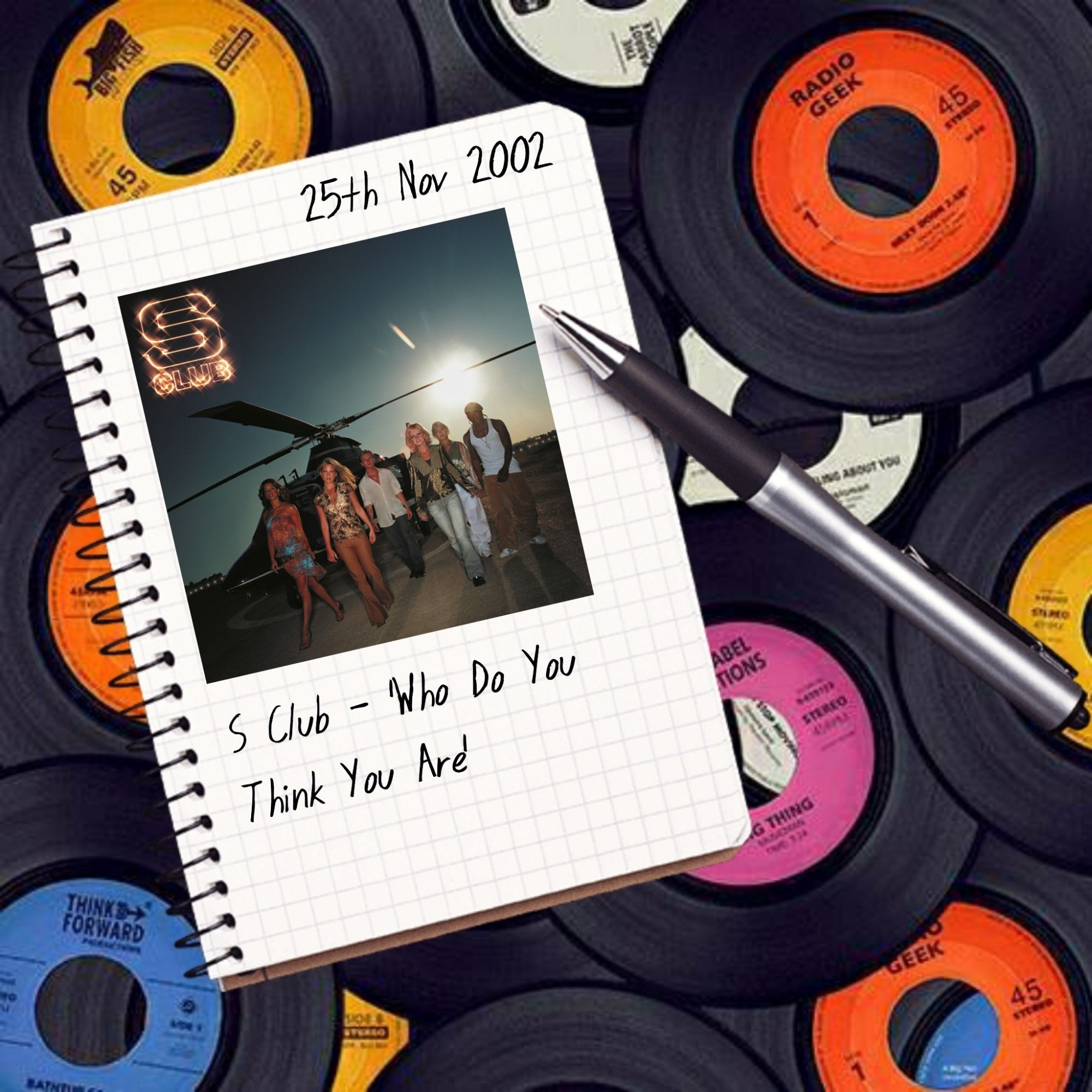
- Artist: S Club
- Song: Who Do You Think You Are
- Released: 25/11/2002 (on Seeing Double album)
- Writers / Producers: Cathy Dennis / Jonny Lisners
- Highest UK Chart Position: #17 (on Official UK Albums Chart)
- Chart Run: 17 – 32 – 48 – 60 – 69 – 61 – 87 – 87 – 99
I am, by and large, a creature of habit when it comes to my music listening. Always have been. In fact, once a year, a period of about a week or two will come around where I am listening solidly to one artist in particular. Sometimes there is a reason for this, but other times, there is no reason except that I just feel like it.
But these periods are always reassuring for me, because it means I don’t have to give too much thought to what is occupying my Spotify (until it cuts to the end of November when my Wrapped reveals I spent more time than I thought during one week in mid-July playing the radio edit of “Honey To The Bee” by Billie Piper).
The last two weeks that has passed in the time prior to writing this has been spent delving into the four albums and a greatest hits’ worth back catalogue of S Club 7. Some of this is because of sentimental reasons – I often refer to them as my comfort band as they were my 10 – 13 year old soundtrack – but also because said period was largely initiated by, and tied into the fact that a few weeks ago marked the second anniversary of the passing of the band’s Paul Cattermole, who tragically died just mere weeks after they announced their 2023 reunion tour from an undiagnosed heart condition.
Anyway, the resulting audial trip down memory lane, coupled with nightly rewatches of my box sets of their TV shows (I even watched S Club 7 Go Wild again, a genius and underrated series of nature travelogues they did around 2000 whilst ambassadors for the wildlife conservation charity WWF) has meant I have been having a solid fortnight long S Club party.
So now seems as good a time as any to dissect one of the lesser decorated S Club songs for this blog, released at what was arguably the most turbulent point of their original run. Because the trajectory from the huge success they’d enjoyed with their third album Sunshine, and their BRIT Award and Record of the Year winning third number one hit “Don’t Stop Movin'” in 2001, to their fourth album the following year, was rapid as it was alarming.
Just mere weeks after they’d completed their sold out Carnival arena tour in support of the Sunshine album in January and February 2002, Paul announced that he was leaving the band, and working his notice up until they played at the Queen’s Golden Jubilee at Buckingham Palace in June, meaning that – not for the last time in their career – they were shaving the 7 from their name to become the now sextet S Club, formed of Jon Lee, Hannah Spearritt, Jo O’Meara, Tina Barrett, Rachel Stevens and Bradley McIntosh.
Now here’s where we’re about to get a bit forensic / constructively critical on two points. The first of which concerning their singles. We would argue that, controversial an opinion as this may be, that S Club were poorly represented by their singles after “Don’t Stop Movin'”. It is no secret that that single was largely responsible for crossing them over to new audiences outside their own fanbase, and was the one single of theirs that wasn’t tied into their TV shows or other multimedia project or platform to accompany it.
But the remaining four singles they released after that, as great as they all were in their own way, were essentially lesser versions of songs from earlier in their career; respectively, we had a redux of “Reach” (“You”), “Never Had A Dream Come True” (“Have You Ever” and “Say Goodbye”) and “Don’t Stop Movin'” (“Alive”). In short, it was Simon Fuller needlessly boxing them in musically, when they’d proved they could evolve and do something different.
One could argue that this was something of a stronghold reaction on his part to the now forgotten “Spliff Club 7” scandal that surrounded the release of “Don’t Stop Movin'”, when Paul, Jon and Bradley were arrested for smoking something they shouldn’t have in public. It meant that, singles wise, they were made to play the safest cards in the book and not disrupt the presumed equilibrium, meaning proposed singles like the gorgeous Rachel led slow jam “Show Me Your Colours” and the spangly Tina led disco belter “Stronger” never saw the light of day beyond their parent albums.
Then there’s the part of the band’s public DNA that was equally as important as the music – certainly at the beginning of their career – which was their acting ventures. Our once yearly rewatch of all the TV shows has led us to believe that their third series, Hollywood 7, in 2001, is where things should have ended on the small screen. Mainly because it bought their TV story as a band full circle, where they finally achieved the fame and success they’d been after in Miami 7 and L.A. 7.
There was absolutely no question they should have made the move into film; in fact, those with long memories will recall that they had form doing slightly longer features on two between-series hour long TV specials, called Back to the Fifties and Boyfriends and Birthdays, that filled in the gaps between their Miami and L.A adventures.
An interview on This Morning in April 2001 saw them discuss plans to make a film right after their first arena tour, S Club Party Live, concluded, which Tina and Paul alluded to being like a pop version of the renowned rock mockumentary flick, This Is Spinal Tap. Certainly, a comedy take on life in a pop band would have made a lot more sense coming right after Hollywood 7, as it would have been in keeping with both the narrative and the camped up style of the TV shows.
What we got instead was Viva S Club, a fourth series set in Barcelona which, despite beautifully mirroring Paul’s departure from the band when it wrote him out of the series (you’re a heartless beast if you’re not moved by this scene where he tells Hannah he’s leaving the band) was now running low on original storyline ideas and laughs. And this was then followed by their actual big screen debut, Seeing Double.
Although it shared a lot of the same writing team as their TV show (including the head writer, Simon’s brother Kim Fuller) it was a half baked and oftentimes confusing caper, where they were kidnapped by a mad scientist and cloned, along with a series of lookalikes (plus actual Gareth Gates) playing clones of Madonna, Michael Jackson and Ozzy Osbourne.
That both these on screen projects ended up being the only ones done without Paul, and that they also came towards the end of the band’s original run when they were literally falling apart (Jo had to sit out the majority of promo owing to a back problem that turned out to be dehydrated discs in her spine that at one point, could have left her wheelchair bound) goes some distance to explaining why they didn’t have nearly the same impact they normally had.
Plus, there’s no getting away from the fact that the launch and success of S Club Juniors – whose debut album Together had gone platinum and spawned no less than four huge hit singles, ultimately going onto outsell the Seeing Double album, meant the impetus was now with them sales and popularity wise – even if that wasn’t the intention.
So, our thoughts on those things established, let’s try to suspend our knowledge of the past, and imagine instead, a world where Seeing Double, for all its flaws as a film, was a massive success and where their audience wasn’t migrating en masse to the Juniors. Because the accompanying album was actually one of S Club’s best from our viewpoint.
Having “Alive” as a lead single wasn’t the smart choice with hindsight, but the rest of the album was a revelation; it was certainly the most dance oriented they had ever gone on their music before, leaning into the same French house groove Madonna had perused on her Music album, via squelchy Euro disco and even a bit of drum’n’bass and UK garage. Yes, really.
And it’s under the latter genre that one track on the album, “Who Do You Think You Are”, finds itself. For context, if you’ve not seen Seeing Double, then it’s the song which acts as one of the big setpiece numbers in the film, where both the real and clone versions of the band get revenge and overthrow the evil scientist, Professor Gaghan. And it is nothing if committed to its theme.
Penned by – who else? – the author of many of the band’s biggest hits, Cathy Dennis, if the juddering, crashing synth stabs, chopped up vocals and 2-step beats sound familiar, it’s because Jonny Lisners – formerly one half of UKG duo the True Steppers, who had famously worked with Victoria Beckham and Dane Bowers on the massive “Out Of Your Mind”, is at the controls here.
Jon and Bradley start the song, the former in quite dramatic fashion, leaning into the musical theatre territory he’d be pursuing post-band: “We’ve been living a lie / We’re not what we seem to be / And we’ve had enough of being fooled, and now we wanna be free (Ahhh) / Yeah we’ve been living a dream (Somebody else’s) / And now we wanna live ours / But we’ve got to leave this game behind / To know who we really are (Ahhh)”.
Jo picks up the bridge, which lyrically is not a million miles away from the likes of “Bring It All Back“: “Don’t let anyone take over your life, no no no / Don’t give up your dreams, and you’ll be alright, no no” – before it takes a darker swerve back to its subject matter – “They can think they control you, but they should have told you / When you’re a clone, you know you’re never alone”.
The chorus is a simple one, but in any other circumstances surrounding the film and album, would rank up there as a classic, fist pumping triumph of an S Club earworm: “Who, who do you think you are? / Do you know for sure? / Now tell me / Who, who do you think you are? / Do you know for sure? / Now tell me”.
It still had the pop appeal that had always been at their heart whilst moving things along. Most fans who’d got into them at 10 years old in 1999 were now likely 14 or 15 in 2002, and so would have surely embraced a more grown up pivot in sound. More importantly, it took the risk that their biggest hit to date had had. In a parallel life, if this had been the first single from Seeing Double, perhaps – musically, at least – S Club’s winding down of operations wouldn’t have been so by the book.
Don’t forget to follow our Pop Essays playlist on Spotify, which includes this and all the songs we’ve written about. What are your memories of this week’s featured song or artist? Let us know your thoughts in the comments below or message us on our Instagram.

 The Niche Reference