
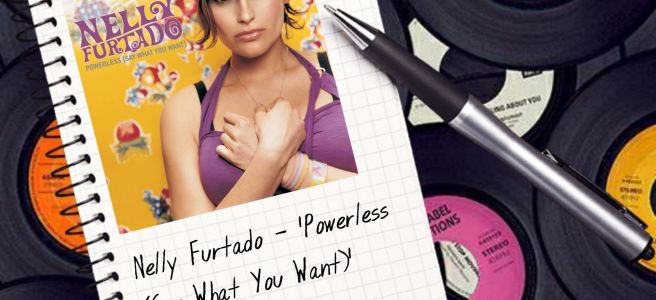

Welcome to this week’s Pop Essays, deep diving once more into the annals of my retro listening and to delve the grooves on some forgotten classics. This week: second album time awaits for one of Canada’s biggest new artists of the 00s…

- Artist: Nelly Furtado
- Song: Powerless (Say What You Want)
- Released: 08/12/2003
- Writers / Producers: Nelly Furtado / Gerald Eaton / Brian West / Trevor Horn / Anne Dudley / Malcolm McLaren / Track & Field
- Highest UK Chart Position: #13
- Chart Run: 13 – 27 – 29 – 24 – 28 – 30 – 37 – 46 – 56 – 63
Nelly Furtado had undoubtedly been one of the more intriguing new pop artists that had launched in the early 00s. With the release of her debut album, Whoa, Nelly! in 2000, she had made a name for herself with a highly eclectic crossover of sounds, incorporating pop, rock, trip hop and world inspired beats, spawning top 10 hits such as “I’m Like A Bird” and “Turn Off The Light”.
That album would eventually go onto sell nearly 6m copies worldwide – going double platinum here in the UK and in the States, as well as reaching four times platinum in her native Canada. Alas, after every debut must come the followup, and in November 2003, it was time for Nelly’s. As its name implies, Folklore was yet another fusion of sounds and styles, but was particularly leaning towards more of a folksy, ethnic sound overall.
Indeed, born to Portuguese parents who had immigrated from the Azores to Victoria, British Colombia in the late 1960s, she explained that the album title was a reflection of this, and was inspired by seeing old photo albums of when they first moved there and embraced a more Westernised way of life, in turn making their own “folklore”.
It also reflected her own story she was building, as she had been pregnant with her daughter during a lot of its writing and recording, so that thus developed and inspired a lot of the lyrical themes of the album and its more mellow sound, particularly on tracks such as “Childhood Dreams”.
But there was still other sonic elements making their presence felt, and the album’s lead single was perhaps the best example of that, as well as being its biggest hit overall. “Powerless (Say What You Want)” was unusual in many ways, and perhaps acted as a good link to crossover from Whoa, Nelly! to the new material.
There’s a lot going on here; for starters, there’s a break beats sample from Malcolm McLaren’s seminal 1982 hip hop banger, “Buffalo Gals”, hence the inclusion of him, Trevor Horn and Anne Dudley on the songwriting credits. It’s also richly layered, with different new sounds being added as the song builds; acoustic guitar and what sounds like mandolin, harmonica, and of course, its signature banjo riff that punctuates the choruses.
Lyrically, whilst being an upbeat song, it touched on Nelly’s own experiences of the industry to that point; not all entirely positive either, as she used her music to speak about how she had come up against a whitewashing of her heritage from both her record label and certain areas of the media: “Paint my face in your magazines / Make it look whiter than it seems / Paint me over with your dreams / Shove away my ethnicity”.
The thematic idea is also expanded on further in the second verse, which touches – quite pointedly and ground breakingly so for a song released in the early 00s – on the idea of cultural appropriation: “I saw her face outside today / Weatherworn, looking all the rage / Took her passion and her gaze / And made a poster / Now it’s moccasins we sport / We take the culture and contort / Perhaps only to distort / What we are hiding”.
But it is pulled together with a sense of hope and reclaiming identity, particularly for those who are in an ethnic minority or don’t feel they fit in, on the affirmative chorus: “Cause this life, is too short / To live in just for you / But when you feel so powerless / What are you gonna do? / Just say what you want, say what you want”.
In a year that had been full of empowering songs becoming massive hits – Christina Aguilera’s “Beautiful” being perhaps the best example of this – it did, in that respect, fit perfectly into the mood of the time, when pop overall was starting to gain a bit more lyrical depth.
If there was one caveat though, it was that by the time November 2003 and Folklore rolled around, it had been three years since Whoa, Nelly! had been released (although its UK release wasn’t until March 2001), and this, lest we forget, was still an era where anything longer than three months since your last release was deemed a significant momentum killer.
Unusually, the album went first before the single, and in the busy Q4 release schedules it got lost in the mix, debuting at a lowly #62. “Powerless” was also even more bravely thrown into the midst of one of the busiest release schedules just a week before that year’s Christmas chart. So the fact that it did well enough to peak at #13 is not to be sniffed at.
Fortunately, the subsequent release of the second single, the moving acoustic power ballad “Try”, which was also a top 20 hit, did hoist the album back up the chart and to its eventual peak of #11 in March 2004. However, its third single, and the official anthem for Euro 2004, “Força”, proved to be its final single, just scraping into the chart at #40 in July, and that was that.
Of course, everyone knows what happened next, when the mighty success of her third album Loose in 2006 saw her hook up with super producer Timbaland, and notch up global chart topping hits with “Maneater” and “Promiscuous” to name but two. However, even for its relative commercial underperformance, Nelly still proved she was an artist not afraid to push boundaries and challenge the norm, which a song as good as “Powerless” does with such confidence and vibrancy.
Don’t forget to follow our Pop Essays playlist on Spotify, which includes this and all the songs we’ve written about. What are your memories of this week’s featured song or artist? Let us know your thoughts in the comments below or message us on our Instagram.

 The Niche Reference