


Well hello to you, and happy Friday! Firstly – yes, this is once again my first blog in three months. Secondly – welcome to Pop Essays, on a Friday, you will note – reasons for which will kick-start your weekend in more ways than one. Because it’s all about the hell of it, it’s all about the game…
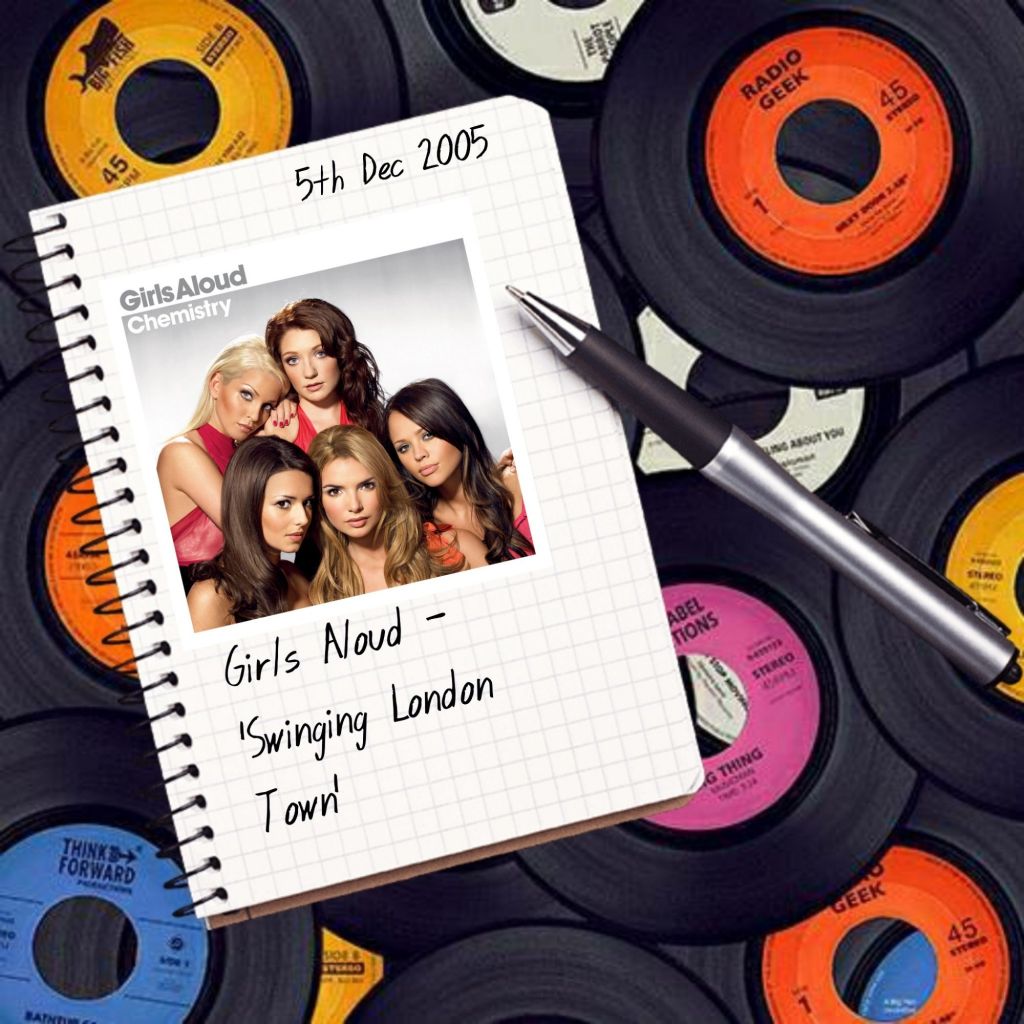
- Artist: Girls Aloud
- Song: Swinging London Town
- Released: 05/12/2005 (on “Chemistry” album)
- Writers / Producers: Brian Higgins / Miranda Cooper / Matt Gray / Tim Powell / Xenomania
- Highest UK Chart Position: #11 (on Official UK Album Chart)
- Chart Run: 11 – 20 – 17 – 29 – 39 – 56 – 55 – 77 – 98 – 66 – 61 – 71 – 97 – 81 – 97 – 90
This week sees the latest instalment of Girls Aloud’s extensive CD and vinyl reissue campaign of their studio albums reach its halfway point, as just in time for its 20th anniversary, their third studio album, Chemistry, is next to get a long overdue revisit – and arguably, receive its flowers it never got at the time.
It’s often said that one downside of success is that people forget the struggles and wobbles that were encountered in order to get there. That is to say, the narrative becomes skewed that success was always there. And Girls Aloud are no different in that respect.
Because one thing that has largely been glossed over – until now, at least – is actually what a tumultuous period this album came at in the band’s career, even though on paper, there was no hint of that being the case; not when they had just released and also toured their hugely successful double platinum second album, What Will The Neighbours Say?, the year before.
Clues that something was amiss had come with the release of the third album’s de facto lead single, in August 2005. Originally pitched to Disney executives for inclusion on the soundtrack of Herbie: Fully Loaded (an ill-fated attempt at resurrecting the series of films about a magic car with a mind of its own, starring a post-Mean Girls Lindsay Lohan), “Long Hot Summer” was famously described by their producer, Brian Higgins, as “a disaster record”.
True, it was the end result of Xenomania’s creative vision coming up against an indecisive set of Hollywood execs who kept changing the goal posts. And that, coupled with the single’s relatively modest chart showing – a #7 entry and peak, followed by a meagre four week stay in the top 40 – did, for a long time, saddle it with a reputation for being one of the girls’ lesser loved singles, one it has only shaken in recent years as it’s become a heatwave anthem, blasted on those now increasingly regular summer days in the UK where it has been 95 degrees in the shade.
It is little wonder then, that the single which followed it, “Biology“, was regarded as the true lead single of Chemistry. A towering pop behemoth comprising three songs in one, it is not only by some distance their best single overall, but also the greatest pop single of the last 20 years, and restored them to their usual top 5 hit ways ahead of the album’s release, in November that year.
However, just as that single was regaining their lost momentum, they were once again immediately hoisted, this time by a snowflake encrusted petard, with the release of another single for Christmas just four weeks later; a pretty but ultimately unnecessary cover version of “See The Day“, originally a hit for Dee C Lee in 1985.
Any hopes that it might repeat the success of their chart topping cover of The Pretenders‘ “I’ll Stand By You” the year before were dashed, when both the Chemistry album stopped agonisingly one place short of the top 10, and that single barely made it into the top 10 at #9. Suddenly, in a chart landscape dominated by boys with guitars in skinny jeans as the tidal wave of indie hit, compounded by US R&B and hip hop at its height and earnest singer-songwriters such as James Blunt occupying the top slot for weeks on end, plus the likes of Top of the Pops, CD:UK and Smash Hits all shutting up shop, Girls Aloud were on the stoniest ground they had been in since the start of their career.
Indeed, anyone who has watched Girls Aloud: Off The Record, the six part fly-on-the-wall documentary series they made for E4 in March 2006 (and which we rewatch at least once a year, the same way some people watch the fourth season of The West Wing over and over), just as the Chemistry album campaign was wrapping up with a fourth and final top 10 hit in the heartbreak ballad “Whole Lotta History”, will know all too well and can see the visible struggle the girls weren’t openly acknowledging but fighting against regardless, in that single’s intense promo campaign.
From friendly encounters with Keisha Buchanan from Sugababes backstage at CD:UK (where she seems more aghast than they are that they’re not nominated in the Best Pop Act category at the BRIT Awards that year), to Sarah Harding reacting despondently to the midweek chart position of the “Whole Lotta History” single, and even in later episodes, numerous instances of her, Kimberley Walsh and even Cheryl openly talking as if it was all but agiven they’d be following the usual pop band trajectory and splitting up not long after the tour for the Chemistry album ended, the overall mood of feeling resigned in the band at that time lingers throughout.
From all of what we’ve described so far, to the uninitiated in Girls Aloud lore, it might sound as if this was the classic instance of a natural decline for a pop group three years into their career, instigated by music that wasn’t cutting it overall and their fanbase growing up. Except that you listen to the Chemistry album, and that theory is immediately bunkum.
Because it is by far and away one of the best albums they did. It was the sound of the girls and Xenomania at their quirkiest, most audacious and most out of the box they had ever been, brimming with irresistible melodies and hooks, reflecting their lives as modern young girls growing up in the public eye in London. The glowing press cuttings the album attained are testament to this, ranging from “It has lyrics that sound like Blur’s Parklife rewritten by the editorial staff of Heat magazine” (The Guardian) and “it achieves the impossible in bettering its predecessor” (musicOMH) to “Pop music has never sounded like this before; most people think pop music isn’t supposed to sound like this. But if only more pop music did.” (The Observer)
Nowhere was this more true than on one of the album’s key high points. “Swinging London Town” was actually a song which had started life with Moonbaby, the short lived vehicle that Xenomania’s main songwriting genius, Miranda Cooper, had fronted. It is also one of the only songs they’ve never performed live from the album.
Opening on chugging 60s spy movie guitar, the phoned-in vocals of Sarah and Kimberley intone: “Do you know the me that wakes / And sees a live wire in her eyes? / The it girl with a twist girl / And no one realises that I’m living on a tightrope / I can’t, I won’t look down / I pussy foot from drink to drink in Swinging London Town / Do you know the me that wakes in places / With faces I’ve never seen? / The mother of all hangovers to remind me where I’ve been / And if I stop, I’m sickened, it really gets me down / So I step back into the city lights, the queen of London Town”.
This then evolves into what can only be described as the sound of Giorgio Moroder if he was platooning a tank bumping bass driven Euro techno over a sports car showroom launch, as Nicola Roberts reels off encounters in New York, Monaco, Paris and Milan with “a big time Gucci girl, a first in retail therapy” and “joke fuelled egos, with Martini swilling charm / Gigolos with stick thin models hanging off their arm”.
It all suddenly drops out dramatically, as glasses politely clink, dreamy lounge piano tinkles and Cheryl breathlessly recounts how “Soho soaks drink Campari / Free flowing bubbly, a drop of gin / Cocktails with price tags to make you choke on your sushi / Dress to impress these bright young things”.
But it’s not long before the Moroder-Eurodisco vibe crashes back in, with Nadine Coyle giving full on sass as she sings: “Do you know the me that greets the faces / In the pages of Hello? / Try hards and die hards, united on the go / Air kissing eligible bachelors and trust fund daddy’s boys / With international playgirls showing off their toys”.
There’s a sense that they’re at once wry observers, yet almost accepting of being swallowed whole by the very same media monster, with Nicola surrendering on her line “I guess I’m neck deep in it, I’m starting to drown / Along with all the wannabes in Swinging London Town”.
As a song, it perfectly encapsulates the madcap nature of the Chemistry album with a relentless, defiant and utterly addictive energy, not to mention on other album highlights like “Models”, “Racy Lacey”, “Waiting” and “Watch Me Go”, all of which would have made for excellent singles if we’d ever got them.
So with this information in mind, just why was Chemistry so universally critically adored but almost entirely overlooked commercially? Well, we’ve touched on some of the reasons so far; the changing music landscape for one, the media corner stones where they were welcomed with open arms dismantling for another.
But it is as if Polydor Records themselves at this point were indecisive. On the one hand, they were wanting to take risks as the girls were by this point renowned for, and seeing the rich rewards of that from both fans and critics, but yet at the same time, they were still needlessly preoccupied with the bottom line, and having something that radio would play and back tracking to cover versions.
It is somewhat telling that by the time they came to release The Sound of Girls Aloud, their first greatest hits album the following year, in October 2006, which topped the charts and went onto sell a million copies, thus putting newfound wind into their sails, that a different tactic had been adopted.
Relying on market research of the time, and pandering to respondents who said they couldn’t buy the girls’ music if they were on the artwork (and who in our view, needed to get their heads out their arses), the corresponding artwork for that album had only their silhouettes (and also embarrassingly, the incorrect use of an Ivory Coast flag next to a Union Jack flag, which was meant to be the Irish flag to represent Nadine and the rest of the girls by the UK flag).
Fundamentally, it took this album for them to realise that Girls Aloud were one of Britain’s last great pop groups standing at that point, and as their label, they needed to make them matter in order for them to sustain and thrive beyond a third album. Because as both 2007’s Tangled Up and 2008’s Out of Control proved, they had plenty more gas in the tank. But ask any hardcore fans – present writer included – and they will tell you that Chemistry is really the album for the hardcore fans, a status it can proudly maintain two decades on.
Don’t forget to follow our Pop Essays playlist on Spotify, which includes this and all the songs we’ve written about. What are your memories of this week’s featured song or artist? Let us know your thoughts in the comments below or message us on our Instagram.

 The Niche Reference