
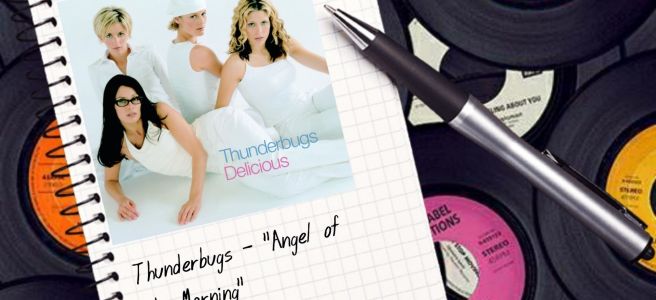

Howdy, readers of this fair corner of the web. It’s been a minute! Lots to bring you up to speed on. That’s for another post tomorrow, but for now, let us dust off and hop aboard our poptastic wayback machine otherwise known as Pop Essays. And this week, we’re back to my favourite pop year, 1999, to shine new light on one of its most high profile new girl groups…
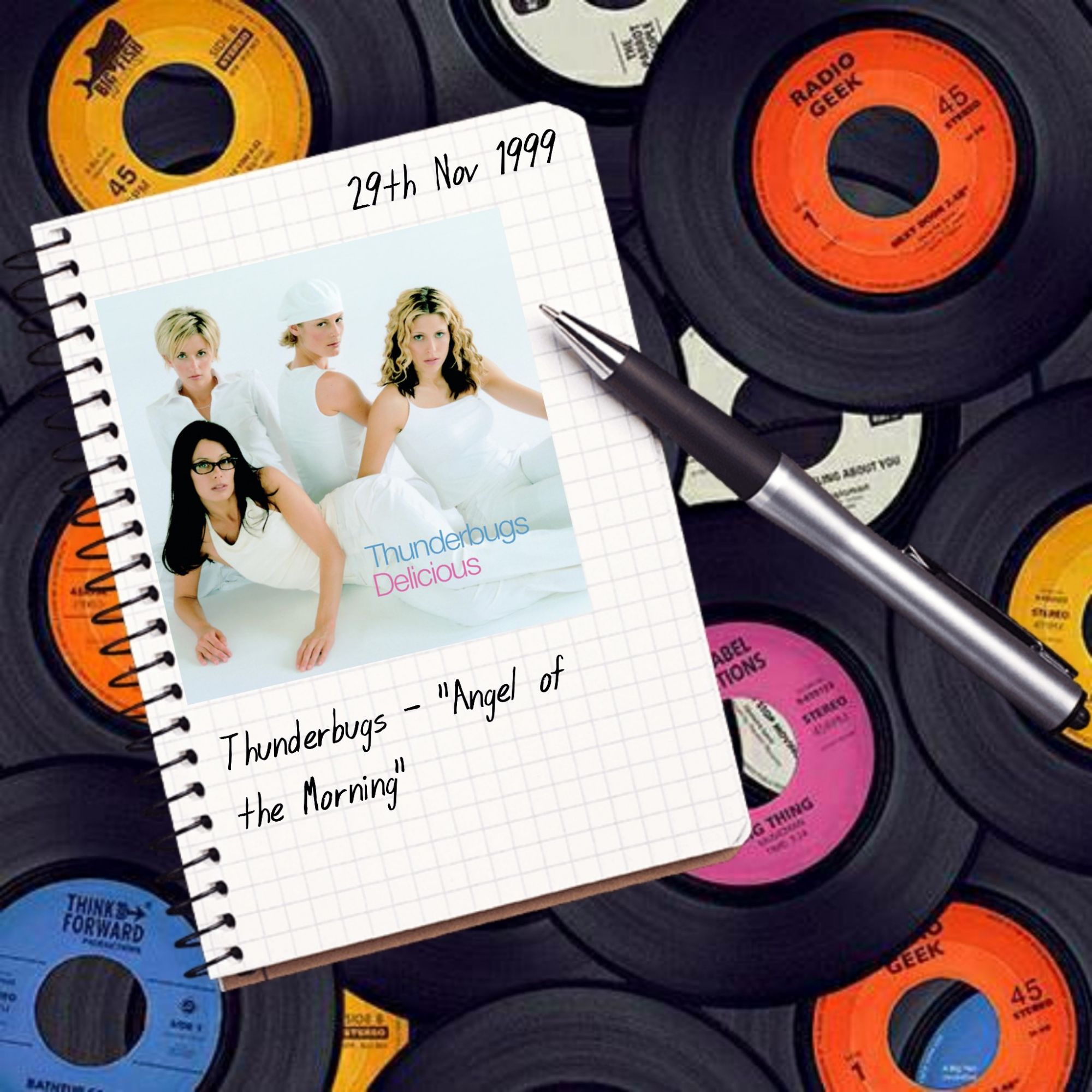
- Artist: Thunderbugs
- Song: Angel Of The Morning
- Released: 29/11/1999 (on “Delicious” album)
- Writers / Producers: Chip Taylor / Rhett Lawrence
- Highest UK Chart Position: Album cancelled – Did Not Chart
- Chart Run: Album cancelled – Did Not Chart
At some point on Pop Essays, I will have basically done a full circumference of the vast explosion of girl groups that sprung up in the wake of the Spice Girls c. late 1997 – early 2002. Now, however, we come to one of the most high profile examples of the genre. Or at least, the most high profile example from 1999, anyway.
Although it’s interesting to note that actually, the genesis of this week’s featured act predates that above timeline by a few months. Consisting of Jane Vaughan (vocals), Stef Maillard (guitar), Brigitta Jansen (bass) and Nicky Shaw (drums), Thunderbugs formed through friends who were gigging in clubs, then started rehearsing together and formed of their own accord.
They’d been writing and recording their own demos as well, one of which happened to land on the desk of one Rob Stringer, then head of Epic Records in the UK at Sony Music. Upon hearing Thunderbugs’ demos, he signed them to a development deal in June 1997, one which would eventually stretch out over the best part of two years.
They did so at an interesting time, as in the mid 1990s, Epic was in something of a purple patch. In Stringer’s time at the label to that point, he had overseen and delivered huge selling and successful album campaigns for Michael Jackson (HIStory), George Michael (Older), Celine Dion (Falling Into You and Let’s Talk About Love) and Manic Street Preachers (Everything Must Go and This Is My Truth, Tell Me Yours).
And then there was also the pop-oriented offshoot of Epic, Gloworm Records, that he’d seen the successful launch of with producer Ray “Madman” Hedges, the first artist on which, B*Witched, had launched to an impressive (and record-breaking) four consecutive UK number one singles, which played a big part in their coffers being that more bulging than a couple of years previously on a pop front.
It is fair to say, and especially having watched back the weekly reruns of Top of the Pops on BBC Four on Fridays (which have recently completed 1999) that on the cusp of a new millennium, it was the year when pure pop was its zenith. Alas, for every Britney Spears, S Club 7 and Westlife, there were another two dozen or so artists either being or waiting to be launched, most of whom were doing so to an evermore distracted audience, where they were starting to be surplus to demand.
And even though Thunderbugs had been touted as ones to watch by industry bible Music Week as far back as January 1998, by the time they were ready for their official launch, there were triple the amount of girl groups around than had been when they signed their development deal. Not to mention that they were the third and last of three to be launched that year who happened to write and play their own music.
First in May had come another Sony Music signing, this time on Colombia Records, which was four piece Cambridge based girl band Hepburn, who notched up a trio of top 20 hits, including their top tenner “I Quit”, which found itself on the soundtrack of Buffy the Vampire Slayer. Then there was 21st Century Girls, Simon Fuller’s glam rocking Midlands teenagers, whose success was limited to their one and only eponymous top 20 hit that June.
So by the time the late summer of that year rolled around, there was a feeling in the air (although unspoken) amongst pop fans, of “Another week, here comes another new act”. Not the best of waters to be launching in. But actually, the fact that Thunderbugs were actively involved in the writing and recording of their music was incredible foresight on the part of Epic Records and Sony. Mainly because it was foretelling of the self written, slightly cooler, rockier sounding direction pop would go in once the 00s got underway, with the emergence of Avril Lavigne and Michelle Branch, and which has continued on in the decades since with the likes of Olivia Rodrigo and Billie Eilish.
Because the songs they had put together for their debut album, Delicious, with writers and producers including Simon Climie and Rhett Lawrence, were accessible yet grown up pop rock, straddling a Venn diagram between Natalie Imbruglia, Belinda Carlisle, Wilson Phillips and The Bangles. Their sound and more sophisticated image was perfectly aimed at the mid-late teen / early twenties demographic they were targeting.
The reason why Thunderbugs’ launch was one of the most high profile of 1999 was because of the sheer amount of budget that was thrown at it by Epic, with almost no expense spared. The first single, a catchy, jangly ode to eternal friendship called “Friends Forever“, was backed with a glossy yet relatable looking video, shot over four days in and around London.
Plus there were those two years in development, writing and recording in London, New York and L.A, a massive TV and print ad campaign with a memorable slogan to accompany it – “Thunderbugs are go!” – and a media showcase launch at Windows on the World, the then newly opened rooftop bar and restaurant on the 26th floor of the Hilton Hotel on Park Lane in London, not to mention all the promo only CDs and vinyls being sent out to radio stations and clubs. Put all those together, and you’re probably talking at least seven figure sums that were being splashed out.
The trouble was that most of this lavish expenditure sat at odds with the kind of band Thunderbugs were, as if this was all but overshadowing their distinct USP – namely, being a self formed proposition and writing and recording their own material – and the most important aspect of it all, which was the music. Regardless, when “Friends Forever” did finally hit the shelves in September 1999, it was a hit, going straight in the UK charts at #5, which showed this was a sound investment, albeit one that perhaps didn’t justify the more excessive spending on their launch.
The real test was, in truth, going to come with their second single and the album. Alas, that is where things went horribly wrong – albeit not of the band’s own doing. The follow up was the unusually titled “It’s About Time You Were Mine“, a midtempo track more indicative of their overall sound, but one that built on the solid base established by their debut, with another glossy video shot on a budget of £100k. It was originally scheduled to come out at the end of November, with the Delicious album to follow a week later at the start of December.
But alas, the fear – although ultimately unfounded – of the so-called Millennium bug and its prospective chaos was still rearing its head. Which is why the run up to Christmas that year was a noticeably quieter affair, with many big name artists – among them, The Corrs, Oasis and Spice Girls – electing to hold back from releasing their new albums until well into 2000. For those artists who were releasing new music, they were doing so in a frantic scramble to have their name out there and a presence in the charts before Y2K arrived.
This culminated into what has now passed into history as the infamous “Chart Massacre” week, when, on Monday 6th December 1999, one week before that year’s Christmas chart, the new release schedule for singles was as packed with names as it had ever been. You had Vengaboys, fresh off the back of their two number ones with the first single from their second album. You had B*Witched (with African choir and Heinz ad soundtrackers Ladysmith Black Mambazo) releasing their Christmas single and looking to regain their chart topping form after their fifth single, “Jesse Hold On”, had broken their run that autumn.
You had in-demand club hits from the likes of William Orbit and Progress presents The Boy Wunda, and the classic debut single from Canadian skate rockers Len. You had Tom Jones and Cerys Matthews from Catatonia releasing a seasonal (if slightly cringey) duet, plus Irish housewives’ favourite Daniel O’Donnell releasing a Christmas track. You had Lou Bega and Enrique Iglesias both releasing follow ups to their Latino craze summertime smashes.
You had TLC, Bryan Adams and Lenny Kravitz all releasing new singles that were following up number one or top 10 hits. Prince and Queen (with David Bowie) were also re-releasing “1999” and “Under Pressure” respectively in time for the new century. All this, plus new singles from The Charlatans, LeAnn Rimes and Nine Inch Nails were all bidding for a chart entry, as well as the still strong sales of existing hits from Artful Dodger and Sir Cliff Richard to contend with. And, lest we forget, in amongst this little lot, there were Thunderbugs with their second single.
Cut to the following Sunday, and almost all the names mentioned above were in for a rude awakening, with many of them failing to make the top 10 or top 20 (or in some cases, the top 40) altogether. It was shocking to the extent that Mark Goodier, hosting the weekly Top 40 show that afternoon on BBC Radio 1, did something unheard of, and actually took time to mention some of the acts that had stopped some way short of the top 40 and their chart positions. And unfortunately, as a result of relatively lower airplay and promo compared to their debut, “It’s About Time You Were Mine” was one of the casualties mentioned in his dispatches, tanking out at #43.
And thus Epic Records, having seen millions of pounds in marketing spend disappear down the plughole, dropped the band, leaving Delicious to only see a limited release in mainland Europe, whilst only getting as far as a release on – the indignity – MiniDisc here in the UK. And so instead of being one of the most successful new girl bands of 1999, Thunderbugs instead became a cautionary tale in what happens when record labels first splash the cash without a thought of making it back, and then timing the release of your artists’ new single carefully.
In an alternate universe where “It’s About Time…” had more sensibly been scheduled for the following January, where it would have been a more reasonably sized hit and had better promo opportunities, it does beg the question of what could have been next for the girls? We believe the answer could have lain in what was touted as their third single.
“Angel of the Morning” was their cover of the Evie Sands, then Merrilee Rush, tune, that had also been recorded by everyone from Olivia Newton-John to Dusty Springfield. And this would have been canny in more ways than one, insofar as it was a song that would be familiar to their mid-late teen audience, as Chrissie Hynde of The Pretenders had memorably covered it in her guest starring role as Phoebe’s Central Perk rival, Stephanie, in the second season of Friends, in the episode “The One With The Baby On The Bus”.
It’s one of those instances where the cover is both delivered perfectly, but also remains in keeping with the sound of their own original material to the extent it doesn’t feel derivative but a natural match. And that was something that wasn’t happening a lot around the turn of the millennium in pop.
Again, the choice of cover proved prophetic with hindsight, as just 18 months later, in June 2001, Shaggy would take his version of the song with Rayvon, “Angel”, to the top of the charts around the globe, the UK included. As for Thunderbugs? Where the girl group explosion of the late 90s were concerned, they were by far one of its most overlooked prospects, and are one worth revisiting with fresh ears.
What are your memories of this week’s featured song or artist? Let us know your thoughts in the comments below or message us on our Instagram.


